
Playout: automation, dead air, logs and now playing
Playout is the one fixed Liquidsoap script between the desk and listeners (ADR-0048); the control plane drives it over a Unix socket and never generates code for it. This page covers what ADR-0044 asks of playout, as release one does it.
Who holds the listener mount
Section titled “Who holds the listener mount”Listeners connect to the listener process (listeners.liq), not to playout.
Playout sends its programme there over loopback (the playout_feed port, 7315), and the listener process encodes the one Ogg Opus stream listeners hear.
When playout or the desk stops, the listener process plays the station’s fallback (the files in its fallback directory, else the default loop, else silence) and listeners stay connected; when playout returns, they hear the programme again without reconnecting.
With video on, playout sends the same programme back to the desk too (the desk_feed port, 7317), for the video stream’s sound while nobody is live (Video in the desk, ADR-0172): from a buffer on a clock of its own, so a desk that stops reading never holds up what listeners hear.
Metadata never travels in the stream: a new track would start a chained Ogg stream, which icecast.server 2.5.0-rc1 answers by dropping every listener.
The feed’s cushion
Section titled “The feed’s cushion”Playout sends its programme to the listener process over loopback, and the listener process keeps a short cushion of it before it plays: listeners.feed_buffer_s in the playout data, 0.5 s unless set, called FEED_BUFFER_S in the Compose bundle’s .env and in the Cloudron package’s weavesignal.env.
The cushion can grow to 10 s at most; whatever it holds is listener delay.
| Server | Set | What the cushion held |
|---|---|---|
| A dedicated 4-vCPU public server | 0.5 s | 0.20–0.38 s over 24 hours, no container restarted and no error |
| A workstation running the Compose stack | 0.5 s | 2 hours with no underrun (ADR-0182) |
| A heavily shared server (load 9–22 on 12 cores) | 3 s | median 8.5 s, and up to its 10 s cap |
So run a station on a server that is not overloaded: there the default holds, and no cushion saves a starved one.
On a busy server the listener process falls behind for moments, and a thin cushion then runs dry: listeners hear the fallback briefly, and the cushion comes back bigger each time, which adds to their delay.
If the log shows listener_programme switching to the fallback while playout is on air, the server is short of time; raising the cushion (1 to 2 s) hides short stalls, and each second added is a second more listener delay.
The Cloudron package sets 1.5 s, because the server it was tested on is shared.
Directory listing
Section titled “Directory listing”The stream does not ask internet radio directories to list it (ADR-0129).
The setting is listeners.directory in the playout data, false unless set; the Compose bundle and weavesignal.sh call it DIRECTORY_LISTING in .env.
Set it to true when the station goes public.
It is separate from search-engine listing of the public pages (web.listed, The public pages) and from whether the stream needs a password.
The MP3 compatibility stream
Section titled “The MP3 compatibility stream”Opus is the listener stream. Directories such as TuneIn and smart speakers that do not take Opus need MP3, so a station may turn on one extra stream (ADR-0002).
It is off unless the playout data says listeners.compat.enabled; the Compose bundle calls its settings COMPAT_STREAM, COMPAT_MOUNT and COMPAT_BITRATE in .env.
| Setting | Default | Does |
|---|---|---|
listeners.compat.enabled |
false |
turns the stream on |
listeners.compat.mount |
programme.mp3 |
its mount on the listener port |
listeners.compat.bitrate |
128 |
constant bitrate in kbit/s, at 44.1 kHz stereo |
The listener process encodes it once, from the same programme as the Opus stream, with LAME (never AAC: Ubuntu’s Liquidsoap links fdk-aac, whose licence keeps the package out of app stores).
It shares the listener port, so it needs no port of its own, and it carries no metadata, like the Opus mount (now playing comes from GET /api/v1/now-playing).
The directory-listing setting above applies to it as to the Opus mount.
The reverse proxy must publish its mount, and a local edge relays only the mounts named in its RELAY_MOUNTS (/programme.opus by default), so add /programme.mp3 there if the edge should serve it.
Listeners on either mount count in the audience figures.
The default loop
Section titled “The default loop”A new station has no fallback files, and silence would greet the first person to open the stream.
Until the station puts its own files in the fallback folder, both Liquidsoap processes play a short loop that WeaveSignal ships (assets/default-loop/default-loop.flac, 32 seconds of a soft synthesised pad with a few quiet bells, at −23 LUFS; the script that makes it is beside it, and it is CC0).
The data names the file (fallback.default_file); without it, or if it is missing, an empty folder is silence as before.
What plays, in order, whenever the desk and automation have nothing:
- the station’s fallback files, in rotation;
- the default loop, only while the folder holds nothing it can play;
- silence.
Files added to the folder take over within seconds, so a station replaces the loop by adding its own fallback and does nothing else.
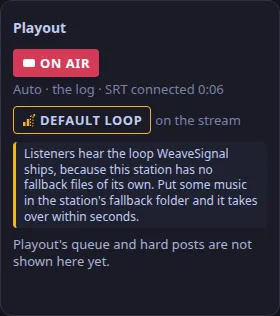
While the loop is on the stream, the studio app says so: the playout panel on the desk (desk.playout) shows a Default loop chip and a line saying why, and a notice appears when it begins and ends.
The loop is not entered in the per-play log (it repeats every half minute), and listeners are told fallback as what is on air.
The control plane reports it as default_fallback in the studio view and in GET /api/v1/playout.
The processing chain
Section titled “The processing chain”Playout runs one chain on everything listeners hear, after the programme is chosen and before it goes to the listener process (ADR-0044):
- a guard that turns not-a-number into silence (a moment of it once left the limiter silent for good);
- a slow gain control towards the station’s loudness target, −16 LUFS by default, a level common for internet streams (the library is normalised to −23 LUFS at import, so the gain control lifts it by up to 6 dB);
- the guard again;
- a peak limiter 1.5 dB under full scale, with no lookahead, then a clip.
The limiter has no lookahead on purpose: in Liquidsoap 2.5 compress with a lookahead reads uninitialised memory on its first frame and, in some starts, goes silent until playout restarts.
The gain control is deliberately gentle: it can add or take away at most 6 dB, rises over about 15 seconds and falls over about 2, and holds still under −50 dB so a quiet room or the desk’s silent bed is not pumped up.
A programme already at the target gets no gain.
It evens out what nothing else processes: the library, the fallback files and the default loop.
processing.status on playout’s control socket says whether it runs, its target and limit, and the gain it applies now.
| Setting | Default | Does |
|---|---|---|
processing.enabled |
true |
false takes the gain control out; the guards and the limiter stay |
processing.target_lufs |
-16 |
the loudness it works towards, −40 to −5 (-23, EBU R128, for a quieter, broadcast-style level) |
processing.max_gain_db |
6 |
the most gain it adds or takes away, 0 to 12 |
The Compose bundle calls them PROCESSING, PROCESSING_TARGET_LUFS and PROCESSING_MAX_GAIN_DB.
There is no multiband stage.
What is on air
Section titled “What is on air”| Mode | On air, in order of preference |
|---|---|
live (default) |
the desk; automation when the desk is away or silent too long; the fallback files; the default loop; silence |
auto |
automation; the fallback files; the default loop; silence |
The desk always sends, even with nobody talking, so it counts as away after dead_air_s (10 s by default) under dead_air_db (−50 dB), set in playout’s data.
That is the dead-air fallback: automation takes over, the desk shows a Dead air notice, and when the desk sounds again it is back on air with a Back on air notice.
The schedule
Section titled “The schedule”| Part | What it is |
|---|---|
| Library | tracks imported through the media worker, each with a category (a, gold, …), title, artist, album, label and ISRC, brought to the loudness target by a stored gain |
| Clock | an hour’s slots in order: a category, or a cart from the wall (an ident); repeated until the hour is full |
| Week | which clock runs each local hour (Monday 0), in the station’s time zone; empty hours run the default clock |
| Rotation | the track rested longest that breaks no rule |
| Separation | artist 60, song 180 and album 60 minutes by default, start to start; relaxed only when nothing else fits, and the log says so |
| US statutory licence | 17 U.S.C. 114(j)(13): in any 3 hours at most 3 tracks from one album (2 in a row) and 4 by one artist (3 in a row); never relaxed |
The control plane keeps the log generated a day ahead and playout’s queue two items ahead.
The log editor replaces a planned track only when the change breaks no rule, or the station’s own rule with force; a US statutory breach is always refused.
Items a live show ran over are skipped, so automation resumes in the current hour.
What the station keeps
Section titled “What the station keeps”| Record | Kept |
|---|---|
| Per-play log | every track, cart and fallback file that reached listeners, with start, end, title, artist, album, label, ISRC, duration and the listeners connected as it started; for retention’s per-play period, holds respected (an hour when the period is 0 days) |
| Listener counts | listener seconds, sessions of at least a minute and the peak, per hour; anonymous, so kept under every preset (ADR-0115) |
| Legal logger | what listeners heard, fallback included, in hourly Ogg Opus files, while the Jurisdiction keeps programme recordings; each hour is registered with retention, which deletes it at the end of its period |
Carts sound in the desk; they reach the per-play log timed when listeners hear them (after the profanity delay), and a cart a dump threw away is marked as not aired and left out of reports.
Now playing
Section titled “Now playing”GET /api/v1/now-playing (and /api/v1/now-playing/events, server-sent events) say what is on air, the track, and the next two items, changing when listeners hear the change (the listener delay).
For a US statutory webcaster the next items are never sent (17 U.S.C. 114(d)(2)(C)(ii)).
Routes
Section titled “Routes”| Route | Does |
|---|---|
GET /api/v1/playout |
the mode, what is on air, dead air, whether the default loop plays, automation’s queue, listeners, the logger |
GET, PUT /api/v1/playout/settings |
time zone, separations, mode, default clock |
GET /api/v1/playout/zone |
the station’s zone and whether anyone has chosen it yet (zone, set) |
GET, PUT /api/v1/library/tracks |
the library; an upload with title, artist, category and optionally album, label, isrc |
DELETE /api/v1/library/tracks/{id} |
remove a track |
GET /api/v1/schedule/clocks, PUT, DELETE /api/v1/schedule/clocks/{id} |
clocks |
GET, PUT /api/v1/schedule/week |
the week’s grid |
POST /api/v1/schedule/generate |
generate the log again for a range (a week by default) |
GET /api/v1/schedule/log |
the log, with each item’s words and any rule it breaks |
PUT, DELETE /api/v1/schedule/log/{id} |
the log editor |
GET /api/v1/reports/plays |
the per-play log as JSON, CSV, or SoundExchange’s Report of Use columns (format=soundexchange) |
GET /api/v1/reports/audience |
listener hours, sessions, peak and tracks per hour (PPL’s webcast report) |
GET /api/v1/logger |
the logger’s recordings and any hour missing in the last day |
GET /api/v1/now-playing, /events |
now playing, public |
Now playing is public. Every other route needs a staff session or the station key; changing playout’s settings (PUT /api/v1/playout/settings) needs an admin.
Text and images CC BY-SA 4.0; code samples AGPL-3.0-only, as the code is. Licences.