The chat service
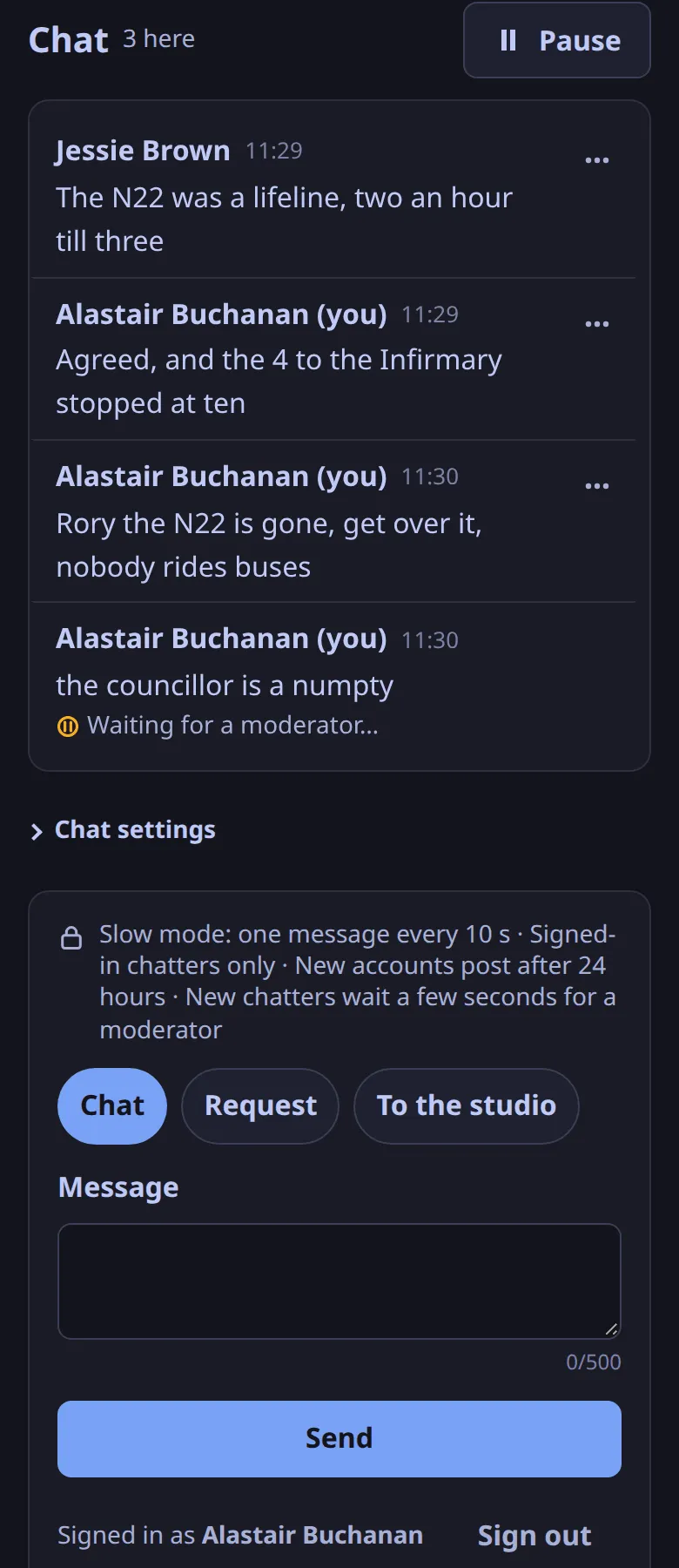
weavesignal-chat is the live chat, its own process beside the control plane (ADR-0031).
It listens on ports.chat (7311) on loopback; the station’s proxy sends everything under /api/v1/chat/ to it, websockets included, never through the CDN.
Settings
Section titled “Settings”weavesignal-chat sample-config prints chat.toml: the station’s identifier and name (the control plane’s), the listen address and port, the control plane’s URL, and how sign-in codes are mailed (off, command for a sendmail-compatible program, or outbox for files).
Secrets come from the environment: WEAVESIGNAL_DATABASE_URL (the station’s database) and WEAVESIGNAL_CONTROL_ADMIN_TOKEN (the studio’s bearer).
The room’s modes (slow, hold new accounts, trusted-only links, influx) live in the control plane; the chat follows its studio view.
The screener’s switches reach the chat at POST /api/v1/chat/modes, and the chat passes them on to the control plane with the caller’s own bearer, so the control plane’s log names who switched a mode.
The station’s own chat settings (terms, the accountable person, the contact point, the minimum age, comments only, guests, blocked words, forbidden names) are kept in the database: GET and PUT /api/v1/chat/admin/settings.
In comments-only mode a chatter cannot reply, and an @mention is plain text: the name stays in the message, but the player page does not highlight it or announce it to the person named (ADR-0147).
The minimum age
Section titled “The minimum age”Signing up, a chatter ticks “I am N or older”; without the tick the chat refuses the account, and a guest’s name, and says why. Only that declaration and when it was made are kept, never a date of birth.
N follows the station’s jurisdiction, the retention preset chosen in Settings (ADR-0148): 13 under No retention, Custom and the UK, US and Canadian presets; 15 under the Australian ones; 16 under Ireland’s, Germany’s and the EU preset.
A change of jurisdiction applies from the next sign-up.
A station sets its own age, 13 to 21, with min_age in its chat settings; leaving it out (or null) follows the jurisdiction again, and so does 13.
A station in Quebec sets 14.
Routes
Section titled “Routes”| Route | Who | What |
|---|---|---|
GET /api/v1/chat/info |
anyone | the station’s terms and contacts, the rules now, report reasons, retention in words |
GET /api/v1/chat/socket |
anyone | the WebSocket; the session goes in the first frame |
POST /api/v1/chat/signin/start, /signin/finish |
anyone | sign in by an emailed six-digit code |
POST /api/v1/chat/guest |
anyone | a guest name, where the station allows guests |
POST /api/v1/chat/notices |
anyone | a notice from someone without an account |
GET /api/v1/chat/me, POST /signout, /reports, /statements/{id}/review |
a chatter | themselves, reports, a review |
POST /api/v1/chat/staff/session |
the studio | the studio’s own chat session |
POST /api/v1/chat/mod; GET /mod/log, /mod/accounts/{id} |
the studio, or a chatter the station made a moderator | moderation |
POST /api/v1/chat/modes |
the studio | a room mode, passed on to the control plane |
GET and PUT /api/v1/chat/admin/settings; GET /admin/accounts/{id}/export, POST …/erase, GET /admin/holds, /admin/risk-assessment |
an admin | the station’s chat settings, export, erasure, evidence holds, a risk-assessment template |
The studio is a staff session (rss_…) or the station key; an admin is a staff session with the admin role, or the station key.
An API token (rsa_…) opens none of the chat’s routes.
These routes are not in the control plane’s API reference.
The frames and shapes are in packages/ui/chat.ts and crates/chat/src/wire.rs.
Every message carries the server’s time and the sender’s playhead (ADR-0038).
A reconnecting page sends its epoch and offset and gets what it missed; a page that falls behind is closed with 4008 and recovers.
What it keeps
Section titled “What it keeps”Email addresses are kept only as a keyed hash (HMAC-SHA-256 under the email key), never the address itself. A sign-in code is kept as a keyed hash too, for ten minutes at most. Chat messages and moderation records follow the station’s Jurisdiction setting (ADR-0113); under No retention, the default, messages go when the scheduled episode they were written in ends (6 hours after they were written, where no episode is scheduled; an episode’s length is its own, or its series’ or show’s slot), moderation records when their 14-day review window closes, and IP addresses are not stored. A retention hold or an escalation keeps what it names until it is released (ADR-0116); an open report stays until it is decided.
The email key
Section titled “The email key”The chat needs one secret to start: WEAVESIGNAL_CHAT_EMAIL_KEY, at least 32 characters (openssl rand -hex 32 makes one).
It keys the hash an address is kept under (ADR-0125).
Someone who copies the database cannot test it against a list of addresses without the key, which a plain SHA-256 would allow.
The key stays outside the database: in the environment of the chat process, never in chat.toml.
- Where it comes from.
weavesignal.shmakesCHAT_EMAIL_KEYin the settings file on its first run and keeps it on later runs; the Compose bundle passes it to the chat asWEAVESIGNAL_CHAT_EMAIL_KEY; the Quadlets store it as the Podman secret<project>-chat-email-key. Run by hand, export it beforeweavesignal-chat serve. - Without it. The chat exits with code 2 and says which variable to set. There is no fallback to an unkeyed hash.
- Keep it with the backups. An account is found by the hash of its owner’s address. With a different key nobody’s address finds their account: they would sign in as new chatters, and their old names would stay taken. The chat does not rotate the key.
- Accounts from before the keyed hash. A station that made chat accounts under the old plain hash keeps them. The chat cannot convert a hash without the address, so it re-keys each account at its owner’s next sign-in, once they have entered a correct emailed code. Until then the chat’s start-up log says how many accounts still hold the old hash. Pending sign-in codes were dropped when the chat was upgraded; a chatter asks for a new one.
Measured on 2026-10-26 on one machine (just test-chat-load): 4,000 sockets, 40 that never read and 200 that reconnect, at 7, 20 and 60 messages a second.
| Rate | p50 | p99 | Server CPU (one core) | Resident memory |
|---|---|---|---|---|
| 7 a second | 16 ms | 29 ms | 23 % | 95 MiB |
| 20 a second | 8 ms | 21 ms | 53 % | 97 MiB |
| 60 a second | 8 ms | 24 ms | 108 % | 97 MiB |
All 200 reconnects recovered. In a longer run (1,000 sockets, 15,000 messages) all 20 sockets that never read were closed with 4008 while the others’ p99 stayed under 60 ms.
Text and images CC BY-SA 4.0; code samples AGPL-3.0-only, as the code is. Licences.